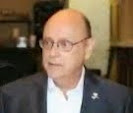


Ann Ravel, Jared DeMarinis & Ciara Torres-Spelliscy, from left (photo: @NYCCFB)
Today, I attend a discussion at the New York University School of Law event, American Elections at the Crossroads, sponsored by the New York City Campaign Finance Board, the Brennan Center for Justice, and the Committee for Economic Development.
Welcoming Remarks - Frederick A.O. (Fritz) Schwarz, Jr., Chief Council (Brennan Center for Justice) and Former Chair, NYC Campaign Finance Board. He gave a history of the NYC Matching Fund Campaign system.
The first panel was titled, "Small Donors vs. SuperPACs":
How has the landscape changed for public financing of elections post-Citizens United? What roles does public financing play in blunting corruption in this ere of unlimited contributions to unregulated third-party spenders? Is the volume of spending causing voters to perceive our elections as spoiled or corrupted?
Moderated by - Ciara Torres-Spelliscy, Brennan Center Fellow, Professor, Florida's Stetson University
Panel Members
John Sarbines, U.S. Congressman (Maryland). He was on Skype from D.C. and talked about H.R. 20: Government By the People Act. To reform the financing of Congressional elections by broadening participation by small dollar donors.
Jay Costa, Executive Director, CounterPAC. During the 2012 Massachusetts Senate race Elizabeth Warren and Scott Brown agreed that if any outside group spent on their behalf that they would give a match to charity out of their own funds. It worked. Outside spending was drastically reduced to merely 9% of total spending in contrast to upwards of 60% in other states. CounterPAC’s mission is to get as many candidates as possible to agree to a similar pledge rejecting untraceable dark money.
Brad Lander, NYC Council Member (Brooklyn 39th District). He talked about NYC's 6 to 1 matching fund system.
Paul Ryan, Senior Council, Campaign Legal Center. He spoke about a tax credit for donating.
Lunch & Afternoon Keynote Speaker - Ann Ravel, Chair, Federal Election Commission (FEC). She talked about the commission and the difficulties of getting changes implemented. She also talked about the improvements to the website and upgrade of the financial disclosure database so it can be viewed in detail.
During the lunch break, I had a conversation with Jared DeMarinis, the Director of Maryland's State Board of Elections.
"Money will always be in politics". In Maryland, Montgomery County's campaign finance program, the first in the country passed after Citizens United v. FEC - the Supreme Court decision that lifted restrictions on political spending by corporations - was designed keeping in mind the altered political environment. "Let's not have the hard caps on expenditures," they decided. "Let's just cap how much public monies we'll give to candidates but allow them to keep raising beyond that but just restrict on how the money is raised." Montgomery's program was "basically modeled after the New York City idea," said DeMarinis.
Due to prior commitments, I was unable to attend the afternoon sessions.
Lawrence Lessig has written an Op-Ed in The New York Times called "The Only Realistic Way to Fix Campaign Finance".
If the core problem is politicians beholden to their funders, then giving Congress the power to limit the amount spent or the amount contributed would not resolve it. Regardless of how much was spent, the private funding of public campaigns, even with limits, would inevitably reproduce the world we have now.
Real reform will require changing the way campaigns are funded — moving from large-dollar private funding to small-dollar public funding.
Democrats, for example, have pushed for small-dollar public funding through matching systems, like New York City’s. Under a plan by Representative John Sarbanes, Democrat of Maryland, contributions could be matched up to nine to one, for candidates who agree to accept only small donations.
CLICK HERE to read Lessig's Op-Ed.

NYC Wins When Everyone Can Vote! Michael H. Drucker


No comments:
Post a Comment